
Traditional school supply lists have been the standard for decades, and for many schools, they still work. Teachers build their lists, schools send them out, and families shop on their own before the first day. That approach is familiar, and in the right setting, it can still be workable.
 But more schools are taking a closer look at whether the list model still holds up as enrollment grows, classrooms become less uniform, and pressure around equity, consistency, and staff time continues to rise. Families are also shopping in a tougher market. The National Retail Federation reported that K–12 families planned to spend an average of $143.77 on school supplies alone in 2025, while Deloitte found that K–12 parents expected to spend about $570 per child across back-to-school categories overall.
That matters because this isn’t just a shopping question. It’s a systems question. Which approach gives classrooms a smoother start? Which one creates less confusion for families? Which one leaves teachers spending less time fixing supply problems in August and September?
That’s the comparison schools are really trying to make.
How traditional school supply lists typically work
The traditional process is simple on paper. Teachers submit supply requests by grade or classroom. The school compiles those lists and shares them with families, usually in late spring or summer. Parents then shop on their own, either in stores or online, and students bring supplies in when school starts.
There’s a reason this model has lasted. It gives families flexibility, and it doesn’t require the school to build a separate ordering process. In a smaller school, or in a school where lists are short and classroom variation is limited, that may be enough.
Still, “familiar” and “easy” are not always the same thing. Deloitte’s 2025 back-to-school survey found that 83% of parents said their household was in a similar or worse financial position than the year before, and spending behavior reflected that pressure.
Where traditional supply lists start to break down
The biggest problem with a list-based system is not the list itself. It is the inconsistencies that show up once parents start shopping.
 Some students arrive with everything. Some arrive with part of the list. Some bring substitutes because the exact item was out of stock, bundled incorrectly, or simply too expensive. Then schools and teachers absorb the mess. Teachers spend time sorting supplies, identifying gaps, and adjusting classroom systems. Office staff answer parent questions about brands, quantities, and teacher-specific requests. None of that is dramatic, but it adds up fast in August.
That strain shows up in teacher spending, too. AdoptAClassroom’s 2025 teacher spending survey found that teachers spent an average of $895 out of pocket on school supplies during the 2024–2025 school year, 97% said the budget provided by their school was not enough, and 81% said the main reason they bought supplies themselves was to make sure every student had the same opportunities in the classroom.
There’s also the equity issue. Supply gaps become visible right away. One student comes in fully prepared, and another does not. That changes the first days of school for teachers and students alike.
Cost pressure also makes the list model harder. The National Education Association reported that typical school supplies for the 2025–26 school year cost an average of 7.3% more than the year before.
How school supply kits change the approach
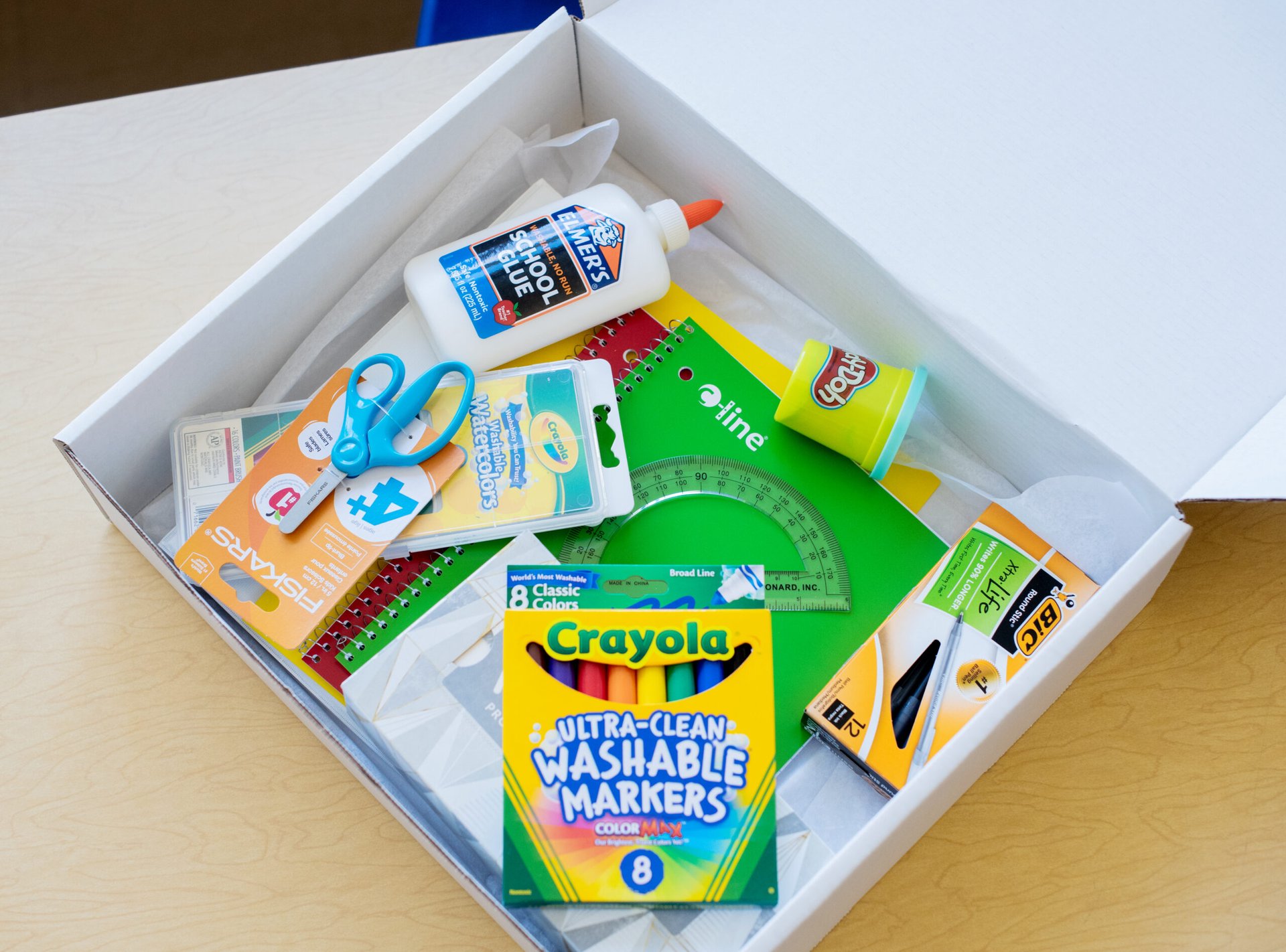
School supply kits do not change the goal. Students still need the same basic materials. What changes is the structure.
Instead of asking every family to interpret the list and shop for items individually, a kit program centralizes the process. Teachers still decide what students need. The lists are then standardized, loaded into an ordering system, and fulfilled as kits that match the approved supplies for that grade or classroom. The best kitting programs do the heavy lifting when it comes to building the online ordering portal, so school administrators aren’t further burdened.
Kitting programs can create more predictability. Families get a defined ordering path instead of a scavenger hunt. Schools get a clearer ordering window. Teachers are more likely to start with the supplies they actually requested. And in most programs, the kits are optional, so families can still shop on their own if that works better for them. It’s also important to look for a kitting program that allows parents to drop products they might already have at home. This helps keep kits affordable and accessible for all.
Comparing kits and lists
 Administrative burden is usually the clearest difference. A traditional list pushes purchasing out to families, but it often pulls troubleshooting back into the school later. A kit program can reduce some of that follow-up because the approved list, product selection, and ordering path are already organized.
Parent experience changes, too. With a list, families may compare brands, check package counts, chase sales, and work around out-of-stock items. That process is getting more compressed. NRF reported that 67% of back-to-school shoppers had already started buying by early to mid-summer in 2025.
Classroom consistency also tends to improve with kits. A list-based system often produces variation in notebooks, folders, binders, and quantities, even when instructions are clear. A kit-based system makes it easier for teachers to start the year with the same core materials across the room.
Cost transparency deserves a fair comparison, though, because this is where schools can oversimplify the decision. A traditional list can look cheaper if families catch sale prices, reuse supplies from home, or substitute lower-cost products. A kit can look more expensive if someone compares its full delivered cost to a handful of sale items from an ad. The more honest comparison is item-by-item, with similar brands, similar quality, tax or shipping where relevant, and the time it takes to finish the list. Here’s a deeper dive into what to look for when comparing prices.
Equity and first-day readiness also look different under each system. When more students begin with the right materials, teachers spend less time filling gaps, and classrooms can settle into routines faster. That does not mean kits solve every barrier. It does mean they can reduce the number of small failures that schools otherwise manage after classes begin.
When traditional supply lists still make sense
Traditional lists are still a reasonable option in some settings.
A smaller school with short, simple lists may not need a more structured program. The same is true if classroom variation is limited, families generally complete lists accurately, and staff do not spend much time each fall answering questions or filling supply gaps.
When school supply kits are the better fit
 Kits tend to make more sense when the current process creates repeat problems.
That often happens in larger schools, in schools with several classrooms per grade, or in schools where lists vary enough to confuse families. It also shows up when staff spend August answering the same supply questions, when teachers regularly fill gaps on their own, or when inequities become visible as soon as students walk in.
Kits may also be a better fit when schools want more predictability around timing. Families are already shopping earlier and under greater budget pressure, which raises the odds of inconsistent results when every household is left to manage the list on its own. NRF and Deloitte both found signs of earlier and more cautious back-to-school purchasing in 2025.
In that kind of environment, a structured kit program is not just a convenience play. It can help reduce friction and make the start of school more consistent.
A simple decision framework for school leaders
The best way to evaluate kits versus lists is to stop thinking only about how families shop and start looking at outcomes:
- Whether teachers are getting the supplies they actually asked for
- How much staff time goes to answering questions and correcting mistakes
- Whether supply gaps show up right away, and whether your current process leaves teachers to smooth them over
- Whether families understand the process clearly, and whether the current system feels simple from their side, not just from the school’s side
If your list process already works, that is useful to know. But if the same supply problems recur every year, the decision is probably less about shopping and more about systems.
A school supply kit program is not the right fit for every school. But for schools that want more consistency, less troubleshooting, and a cleaner start to the year, it can be the better one.
