
.jpg?width=1920&length=1920&name=Kid-and-kit-32%20(1).jpg)
School supply drives are a familiar part of the back-to-school season. Most communities have participated in one — whether through a workplace collection, a local nonprofit, or a school-organized effort. But familiarity doesn't always mean clarity. School leaders and PTOs tend to have more specific questions than general enthusiasm alone can answer.
This FAQ covers what schools and non-profits actually ask when they're evaluating whether to run a drive, how to structure it, and what to expect.
What Is a School Supply Drive?
A school supply drive is an organized effort to collect or fund essential classroom and student supplies through community support. The goal is to ensure students and teachers have what they need for the school year, without relying entirely on families or school budgets to cover the gap. These typically involve essential supplies, rather than “nice-to-have” supplies.
Modern drives may involve collecting physical items, raising funds, or using kit-based or virtual giving models where donors contribute online toward specific supply packages. The format has evolved a lot over the past decade (especially post-pandemic) and schools have more options than the traditional “box-in-the-lobby” model.
How Do School Supply Drives Typically Work?
At a high level: organizations identify what's needed, choose a drive model, communicate with donors or community partners, and distribute supplies to classrooms or students once the drive closes.
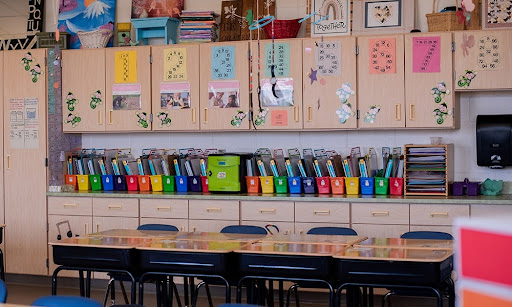
In practice, the specifics vary a lot. A school running its own drive internally looks different from a community organization running a city-wide collection that feeds multiple schools. The common elements in a well-run drive are:
- A clear goal tied to actual needs, not just "as much as possible"
- A defined collection window with a hard deadline
- Simple, specific asks that make it easy for donors to contribute
- A distribution plan that's ready before supplies arrive
The planning part is where most drives succeed or fall short. Logistics managed at the end of a drive (after supplies are already in) create unnecessary chaos.
Who Usually Runs a School Supply Drive?
It depends.
Often, local nonprofit organizations will collaborate with community members and their chosen recipient school to run a school supply drive. For communities with large organizations, like United Way, Catholic Charities, Lutheran Social Services, etc, the supply drive may serve an entire region rather than a specific school or district.
Occasionally, businesses will choose to run a school supply drive to support a specific school or district. If large enough in scale, they will choose to run a supply drive outside of an established non-profit drive.
When a school decides to run a supply drive directly, it’s often the PTO or PTA leaders that take the lead, with administrative support and approval from the school. In others, administrators or operations staff manage the program, often with volunteer support from parent volunteers.
The most successful drives, regardless of who owns them, have one clear point of contact. When responsibility is shared loosely across multiple people without a defined lead, communication gaps and missed handoffs are common.
What Supplies Are Typically Collected?
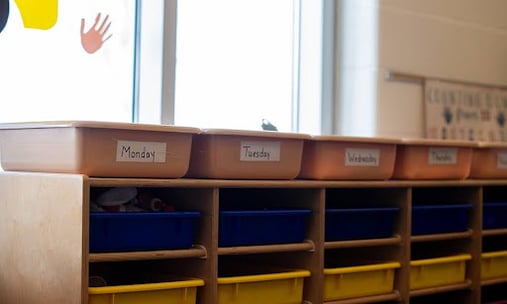 The most consistently needed items are the basics: paper, pencils, pens, folders, notebooks, and glue sticks. These are consumable supplies that run out and get used across every grade level.
The 2025 AdoptAClassroom.org teacher survey found that 82% of teachers spend their own money on basic supplies — paper, pencils, and markers — first. That's a useful signal for what drives should prioritize.
Drives that chase more visible or exciting items (backpacks, headphones, specialty supplies) sometimes collect a lot of goods that aren't distributed because they don't match actual needs. Starting with what teachers actually asked for produces better outcomes than starting with what donors want to give.
How Do Schools Decide Who Receives Supplies?
This is one of the most important questions, and it doesn't always get the attention it deserves.
Common approaches include:
- Classroom-level distribution: Supplies go to every classroom rather than being distributed to individual students. This is often the most equitable model because it doesn't require students or families to identify themselves as "in need".
- Grade-level packs: Supplies are assembled by grade level and distributed uniformly, so every student in a given grade receives the same materials.
- Needs-based allocation: Schools direct supplies to specific students or families who have indicated they need support — most effective when done discreetly and with dignity.
The distribution model should be part of the plan from the start, not something figured out after supplies are sitting in a storage room.
Are Item Drives or Monetary Drives More Effective?
Both have trade-offs.
Item drives are tangible and easy for donors to understand. But they can produce uneven results: too many of one thing, not enough of another, and inconsistent quality depending on what donors happen to have or choose. They also require space for storage and staff time for sorting.
Monetary drives give schools more flexibility to buy exactly what's needed at better prices through bulk purchasing. They're also easier to run with a wider geographic donor base (anyone can give online). The challenge is making monetary giving feel as concrete as dropping off a box of pencils.
Many schools now use a hybrid: online giving tied to specific items or kit packages, so donors can contribute money and still feel the tangibility of knowing a student gets a backpack or a supply kit. And in some cases, those same donors can be engaged through a community kit assembly event.
What Are Common Challenges with School Supply Drives?
A few come up consistently:
- Mismatched donations: Supplies that don't reflect actual classroom needs create sorting work and inventory waste.
- Late planning: Compressed timelines reduce participation and push distribution into the first days of school — exactly when staff are busiest.
- Storage constraints: Schools often underestimate how much space a physical drive requires before distribution.
- Volunteer burnout: Sorting and distributing large volumes of physical supplies is labor-intensive. Drives without enough volunteer support create staff burden.
- Equity gaps: Drives that don't plan for equitable distribution can inadvertently highlight which students "needed" help.
Most of these are planning problems, not structural flaws. They're solvable with earlier preparation and a more deliberate design.
When Should Schools Start Planning a Supply Drive?
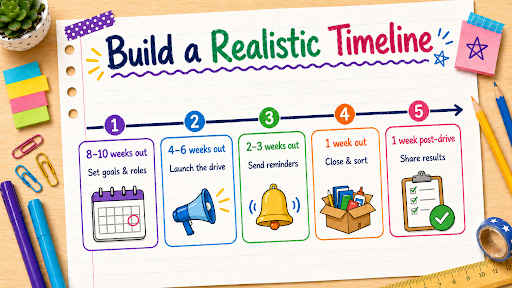
Earlier than most do. Schools that start planning in the spring, rather than July, have significantly more time to align on supply needs, build community relationships, recruit donors, and prepare for distribution.
The National Retail Federation's 2025 data found that 67% of back-to-school shoppers had already started buying by early July. Donors follow a similar pattern: community engagement peaks well before August. Drives that launch in July often miss a meaningful portion of potential supporters who've already made their giving decisions.
A general rule: if you want supplies in classrooms by the first day of school, your drive should be closed at least three weeks before that date. Work backward from there.
Where Can Schools Learn More or Get Support?
Schools looking for a more structured approach, one that takes the logistics off their plate, can learn more about what a managed supply program looks like through Impacks. Impacks works with schools, non-profits, and businesses across the country to manage supply programs from sourcing to delivery, including support for donation matching and equity-focused distribution. It's a useful resource whether you're exploring a full program or just looking to understand your options.
