
Most school supply drive problems aren't caused by bad intentions or lack of effort. They come from planning gaps that snowball once the drive launches. The donations show up, the deadline hits, and suddenly there are 400 mismatched items to sort, store, and figure out how to distribute before school starts in a few days.
These mistakes show up repeatedly, across different school sizes and community types. Recognizing them early is usually the difference between a drive that builds momentum year over year and one that quietly gets dropped after two seasons. And catching these mistakes early is made all the more important when the supply drive is being run by a nonprofit or business outside of the school itself.
Mistake: Starting Without Clearly Defined Needs
 The most common problem in school supply drives isn't lack of generosity - it's lack of direction. A drive that asks for "school supplies" without specifying what, in what quantities, and for which grade levels will collect whatever donors happen to have or choose. That might mean 150 boxes of crayons and a shortage of composition notebooks, or a stack of high school binders donated to a K-2 school.
Before the drive launches, someone needs to answer:
- Which classrooms or students are being served?
- What specific items do they need, and in what quantities?
- Are there items that should be excluded because they're already covered?
The 2025 AdoptAClassroom.org survey found that 82% of teachers spend their own money on basic consumables: paper, pencils, markers. If you don't know where to start, start with the basics. While the idea of buying branded folders or sparkly notebooks is fun, these are often deemed unnecessary by the teacher, and can cause bullying in the classroom. If you ask teachers, often they desperately need the less exciting essentials. Coordinate with school staff to ask teachers what they need before the drive opens. It takes very little time and could completely change what you collect.
Mistake: Relying Solely on Item Donations
Physical item drives feel tangible and easy to communicate. But they create problems that aren't obvious until you're standing in front of 300 mismatched bags of supplies trying to figure out what to do with them.
 Common issues with item-only drives:
- Duplicate donations in some categories, near-zero in others
- Inconsistent quality — some donors bring name-brand supplies, others bring off-brand items that teachers have specifically requested not to bring
- Storage constraints if the collection window runs long
- Significant volunteer time required for sorting, organizing, and distributing
Virtual and monetary drives — or hybrid models where donors contribute to pre-specified kits — solve most of these problems. Donors get specificity ("your $35 covers one student's full kit"), and schools get predictability in what's received. It's a better system for both sides.
Typically, these kits can either be assembled by a school supply partner, or they can be assembled by volunteers in an engaging community packing event.
Mistake: Underestimating Logistics
Logistics is where supply drives most often collapse in the final stretch. Schools focus so much on the collection phase that they don't plan for what happens after the drive closes.
Questions that should be answered before the drive launches:
- Where will physical donations be stored? Is there actually enough space?
- Who is responsible for sorting — and do they have enough time and help?
- How will supplies get from the collection point to the right classrooms?
- Is there a way to track what was received vs. what was needed?
- Do you have the right administrators involved to make sure distribution goes smoothly?
A drive that collects 500 items but can't sort and distribute them before the first day of school hasn't actually helped anyone yet. Distribution logistics should be planned in the same detail as the collection campaign.
Mistake: Waiting Too Long to Plan
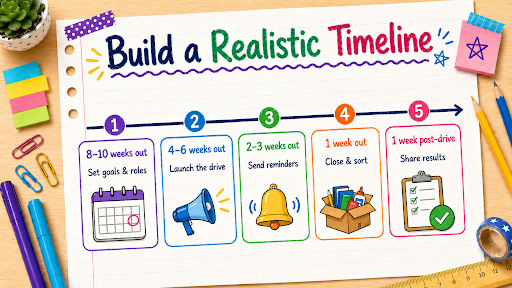
Back-to-school season runs on a tighter timeline than most people realize. Schools have open houses, teacher setup days, and communications going out weeks before the first day of class. Drives that launch in late July are competing with that noise — and often losing. If you’ve ever dropped off donations to frazzled school staff during the first few days of school, you may have felt that the donations weren’t appreciated. That’s rarely the case. Rather, staff are often overwhelmed during the weeks directly leading up to and following the start of school.
The National Retail Federation found that 67% of back-to-school shoppers had already started buying by early July 2025, and community donors follow similar patterns. When you launch a drive in late July, a meaningful portion of donors have already made their giving decisions for the summer.
Spring planning is worth it. Even if the drive doesn't open until June, having goals set, models chosen, and communication ready means the launch is deliberate rather than frantic. If you’re working on a large-scale supply drive that involves bulk purchasing, those purchases will often need to be placed in advance to secure the inventory.
Mistake: Treating Equity as an Afterthought
Supply drives are often designed around the question of "how do we collect enough?" without enough attention to "how does this get to students in a way that preserves their dignity?"
When distribution isn't planned carefully, visible disparities emerge. Some students walk away with a complete kit; others get whatever was left after the better items were taken. Or the process of receiving supplies singles out specific students as "the ones who needed help", exactly the kind of visibility that undermines what the drive was trying to do.
 Building equity into the design from the start means:
- Prioritizing classroom-level or grade-level distribution over individual handouts where possible
- Ensuring all students in the target group receive the same items — not just whoever gets there first
- Planning private, discreet channels for families who need additional support beyond the standard distribution
A drive that collects the right supplies and distributes them in a way that respects students is a genuinely equitable program. That requires planning, not just intention.
How Schools Can Avoid These Challenges
Most of these issues are solvable with a few deliberate planning steps:
- Start with teacher or administrator input on actual supply needs before building the donor ask
- Consider virtual, monetary, or kit-based models rather than defaulting to item collection
- Map out the logistics (storage, sorting, distribution) before the drive opens
- Build in at least six weeks between launch and the first day of school
- Design the distribution model with equity and student dignity in mind
Schools that want a more turnkey approach — one that removes most of the logistics burden from staff — can learn how Impacks manages school supply programs from sourcing through delivery. For schools that have run drives before and want to simplify them, it's worth a conversation.
